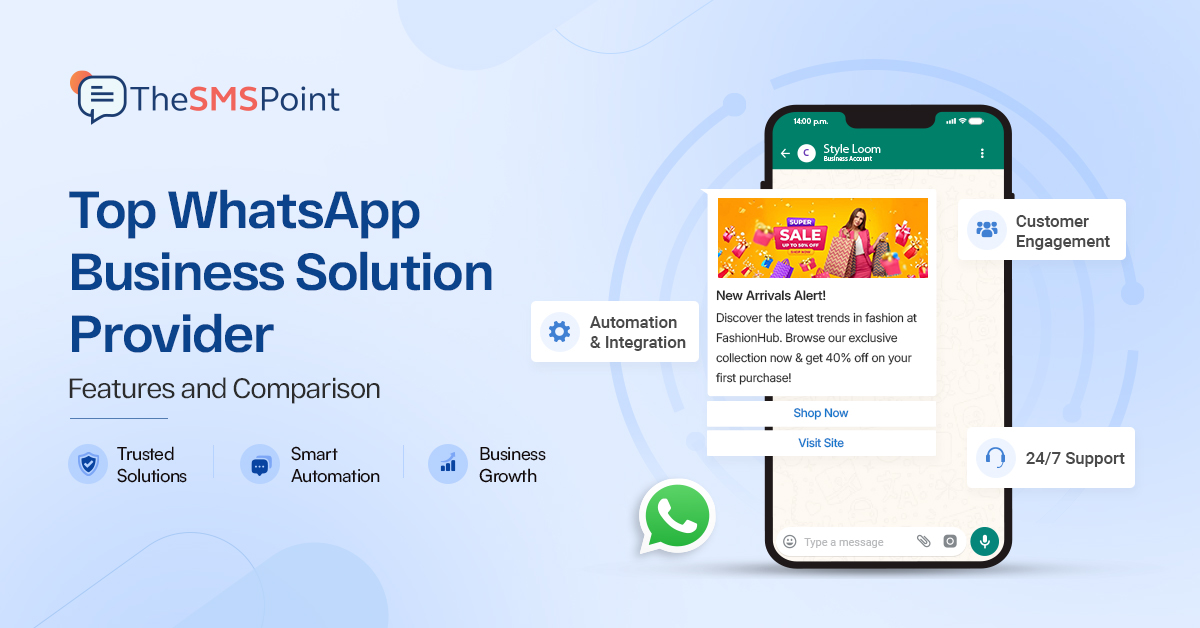
WhatsApp has become one of the most powerful communication channels for businesses. From customer support and order updates to lead generation, appointment reminders, promotional campaigns, and automated conversations, companies are now using WhatsApp not just as a messaging tool but as a complete customer engagement platform.
In 2026, the demand for WhatsApp Business solutions has increased because customers expect faster responses, personalized communication, secure interactions, and real-time support. At the same time, businesses need scalable systems that can manage high message volumes, automate routine conversations, integrate with CRM or ERP systems, and follow Meta’s messaging policies.
This is where a WhatsApp Business Solution Provider plays an important role. The right provider helps businesses access the WhatsApp Business Platform, manage customer conversations professionally, automate workflows, and improve communication efficiency across sales, support, marketing, and operations.
For growing businesses, choosing the right WhatsApp Business Solution Provider is not only a technology decision. It directly affects customer experience, campaign performance, support quality, compliance, and long-term digital growth.
What is a WhatsApp Business Solution Provider?
A WhatsApp Business Solution Provider is a technology partner that helps businesses use the WhatsApp Business Platform for large-scale communication. Unlike the regular WhatsApp Business App, which is suitable for small teams and basic communication, the WhatsApp Business Platform is designed for businesses that need automation, multiple users, API-based messaging, chatbot integration, template messages, analytics, and system connectivity.
A solution provider helps businesses with setup, configuration, integration, message template approval, workflow automation, team inbox management, and technical support. This allows companies to communicate with customers in a structured, secure, and scalable way.
With the help of a WhatsApp Business Solution Provider, businesses can manage customer inquiries, send important notifications, run marketing campaigns, automate replies, share order updates, generate leads, and connect WhatsApp with existing tools such as CRM, eCommerce platforms, ticketing systems, or internal business applications.
Why Businesses Need WhatsApp Business Solutions in 2026
Customer communication has changed significantly. People no longer prefer waiting for long email responses or calling support teams repeatedly. They expect quick, simple, and direct communication on platforms they already use every day.
WhatsApp gives businesses an opportunity to meet customers where they are most active. However, managing WhatsApp manually becomes difficult when the number of customers, inquiries, campaigns, and support requests increases.
A professional WhatsApp Business solution helps businesses solve these challenges by offering:
1) Centralized customer communication
2) Multi-agent team inbox
3) Automated responses and chatbots
4) Approved message templates
5) Broadcast and campaign management
6) CRM and ERP integration
7) Customer journey automation
8) Real-time performance tracking
9) Secure and policy-compliant messaging
In 2026, businesses are focusing more on automation, personalization, and measurable engagement. WhatsApp Business solutions help organizations reduce manual work, improve response time, and deliver a better customer experience.
Key Benefits of Using a WhatsApp Business Solution Provider
Faster Customer Response
Customers expect quick replies. A WhatsApp Business solution allows businesses to respond instantly through automated replies, chatbot flows, and agent assignment. This helps reduce waiting time and improves customer satisfaction.
Better Lead Management
WhatsApp can be used effectively for lead generation. Businesses can capture leads from websites, landing pages, social media ads, Google Ads, and Click-to-WhatsApp campaigns. These leads can be routed to sales teams automatically for faster follow-up.
Automated Notifications
Businesses can send automated updates such as order confirmation, payment reminders, delivery status, appointment reminders, ticket updates, renewal alerts, and service notifications.
Personalized Campaigns
Instead of sending generic promotional messages, businesses can segment customers based on interest, purchase history, location, inquiry type, or engagement level. This makes campaigns more relevant and improves conversion chances.
Team Collaboration
A shared WhatsApp inbox allows multiple team members to handle customer conversations from one platform. This is useful for sales, support, operations, HR, healthcare, education, retail, finance, and service-based businesses.
Integration with Business Systems
The WhatsApp Business Platform can be connected with CRM, ERP, eCommerce, helpdesk, HRMS, LMS, billing systems, and other internal software. This helps businesses automate communication based on real-time business data.
Improved Reporting and Tracking
Modern WhatsApp Business solutions provide dashboards to track message delivery, response time, agent performance, campaign engagement, chatbot activity, and lead conversion.
WhatsApp Business Platform Pricing in 2026: What Businesses Should Know
WhatsApp Business pricing has evolved over time. In 2026, businesses need to understand how message categories, delivery-based charges, and provider platform fees work before selecting a solution.
WhatsApp Business Platform messages are generally categorized into:
Marketing Messages
These are promotional messages used for offers, product updates, retargeting, announcements, and sales campaigns.
Utility Messages
These are transactional or service-related updates such as order confirmation, payment updates, delivery information, booking reminders, and account alerts.
Authentication Messages
These are used for verification purposes such as OTPs, login codes, and identity confirmation.
Service Messages
These are messages sent within the customer service window when a customer starts a conversation with the business.
Before choosing a provider, businesses should clearly understand:
1) Meta’s official messaging charges
2) Provider platform fees
3) Monthly subscription charges
4) Setup or onboarding charges
5) Chatbot or automation charges
6) Broadcast campaign limits
7) User or agent-based pricing
8) Integration charges
9) Support and maintenance costs
Transparent pricing is very important. Businesses should avoid selecting a provider only on the basis of a low starting price. The total cost should be evaluated based on message volume, features, integrations, automation requirements, and long-term scalability.
How to Choose the Right WhatsApp Business Solution Provider in 2026
Selecting the right provider requires careful evaluation. A good provider should not only offer WhatsApp access but also support business goals, automation needs, integration requirements, and compliance expectations.
Check Official Platform Support
The provider should support proper WhatsApp Business Platform setup, business verification assistance, phone number configuration, message template setup, and policy-compliant communication.
Businesses should also check whether the provider understands Meta’s messaging rules and can guide them in maintaining account quality.
Evaluate Automation Features
Automation is one of the most important factors in 2026. A good WhatsApp Business solution should support:
1) Chatbot flows
2) Auto-replies
3) Lead qualification
4) Customer segmentation
5) Workflow automation
6) Agent routing
7) Follow-up reminders
8) Campaign automation
The solution should reduce repetitive manual work and help teams focus on high-value conversations.
Review CRM and System Integration
A WhatsApp solution becomes more powerful when it is connected with existing business systems. Businesses should check whether the provider supports integration with:
1) CRM software
2) ERP systems
3) eCommerce platforms
4) Ticketing systems
5) HRMS platforms
6) Billing software
7) Lead management tools
8) Custom web applications
Integration helps businesses automate communication and maintain proper customer records.
Check Team Inbox Features
For businesses with multiple users, a shared team inbox is essential. It should include:
1) Multi-agent access
2) Conversation assignment
3) Internal notes
4) Chat labels
5) Customer history
6) Agent performance tracking
7) Role-based access
8) Escalation management
This helps teams manage WhatsApp communication professionally.
Understand Broadcast and Campaign Capabilities
WhatsApp campaigns should be managed carefully with approved templates and customer consent. A good provider should support campaign planning, segmentation, scheduling, template management, delivery tracking, and performance reporting.
Businesses should avoid sending irrelevant or excessive promotional messages, as this may affect customer experience and account quality.
Look for Reporting and Analytics
Analytics help businesses understand how customers are engaging with WhatsApp communication. Useful reports include:
1) Message delivery status
2) Read rate
3) Response rate
4) Campaign performance
5) Agent response time
6) Chatbot completion rate
7) Lead conversion status
8) Customer interaction history
These insights help improve communication strategy.
Consider Scalability
The provider should support current business requirements as well as future growth. As the company expands, the solution should be able to handle more users, more messages, more departments, more automation flows, and more integrations.
Review Security and Data Privacy
Business communication often contains customer details, order information, payment updates, support requests, and personal data. Therefore, the provider should follow secure data handling practices and offer role-based access, secure hosting, audit trails, and privacy-focused implementation.
Check Support and Onboarding Quality
A reliable provider should offer proper onboarding, training, documentation, technical support, and issue resolution. Businesses should check how quickly the provider responds to support requests and whether they provide implementation assistance.
Important Features Every Business Should Look For
A professional WhatsApp Business solution in 2026 should include the following features:
Shared Team Inbox
A centralized inbox for sales, support, marketing, and service teams to manage all WhatsApp conversations from one place.
Automated workflows to answer common questions, collect customer details, qualify leads, and guide users through predefined journeys.
Message Template Management
Support for creating, submitting, approving, and managing WhatsApp message templates for notifications and campaigns.
Broadcast Campaigns
Ability to send approved messages to selected customer groups with proper segmentation and reporting.
Integration with CRM or lead management systems to track customer details and conversation history.
Customer Segmentation
Ability to categorize customers based on interest, inquiry type, service requirement, location, purchase stage, or engagement status.
Analytics Dashboard
Real-time reporting for campaign performance, message delivery, agent activity, and customer engagement.
Role-Based Access
Controlled access for different users such as admin, sales team, support team, marketing team, and management.
API Integration
API support for connecting WhatsApp with websites, mobile apps, portals, ERP systems, HRMS, eCommerce platforms, and custom applications.
WhatsApp Business Use Cases for Different Industries
Retail and eCommerce
Retail and eCommerce businesses can use WhatsApp for product inquiries, order updates, abandoned cart reminders, delivery tracking, promotional campaigns, and customer support.
Healthcare
Hospitals, clinics, and healthcare providers can use WhatsApp for appointment reminders, health checkup notifications, patient support, report updates, and follow-up communication.
Education
Schools, colleges, coaching institutes, and edtech companies can use WhatsApp for admission inquiries, fee reminders, class updates, event notifications, and student support.
Real Estate
Real estate businesses can use WhatsApp for project inquiries, site visit scheduling, brochure sharing, lead nurturing, and follow-up reminders.
Finance and Insurance
Finance and insurance companies can use WhatsApp for policy reminders, renewal notifications, document collection, customer verification, and service updates.
Manufacturing and Enterprise
Manufacturing companies can use WhatsApp for dealer communication, internal alerts, customer service, order status updates, and operational coordination.
Travel and Hospitality
Travel agencies, hotels, and tourism businesses can use WhatsApp for booking confirmation, itinerary sharing, payment reminders, travel updates, and customer assistance.
Common Mistakes to Avoid While Choosing a Provider
Many businesses select a WhatsApp Business Solution Provider without properly checking long-term requirements. This can lead to technical limitations, high costs, poor support, and migration challenges.
Businesses should avoid these mistakes:
1) Choosing only on the basis of lowest price
2) Ignoring message category pricing
3) Not checking integration capability
4) Not reviewing automation limitations
5) Ignoring customer support quality
6) Sending promotional messages without consent
7) Not planning customer segmentation
8) Not checking reporting features
9) Using WhatsApp only as a manual chat tool
10) Not aligning WhatsApp with sales and support workflow
The best approach is to evaluate the provider based on business goals, scalability, compliance, automation, integration, and support.
Why WhatsApp Business Solutions Matter for Digital Transformation
Digital transformation is not only about building websites or mobile apps. It is also about improving how businesses communicate with customers. WhatsApp Business solutions help companies create a faster, more connected, and more responsive communication system.
With the right implementation, WhatsApp can become a strong channel for:
1) Customer engagement
2) Sales conversion
3) Support automation
4) Lead nurturing
5) Service updates
6) Customer retention
7) Feedback collection
8) Marketing communication
Businesses that adopt structured WhatsApp communication can reduce manual follow-ups, improve customer experience, and increase operational efficiency.
How NTSPL Can Help Businesses with WhatsApp Business Solutions
NTSPL helps businesses implement professional WhatsApp Business communication solutions based on their operational needs. From consultation and setup to automation, integration, and support, NTSPL assists organizations in building a scalable and efficient messaging ecosystem.
NTSPL can support businesses with:
1) WhatsApp Business solution consultation
2) Business communication workflow planning
3) Chatbot and automation setup
4) CRM and ERP integration
5) Lead management workflow
6) Campaign planning and execution support
7) Customer support automation
8) API-based integration
9) Reporting and analytics setup
10) Technical assistance and maintenance
Whether a business wants to improve customer support, automate notifications, manage leads, or run personalized campaigns, NTSPL can help design a practical and scalable WhatsApp communication solution.
Final Thoughts:
In 2026, WhatsApp Business is no longer just a messaging channel. It has become an important part of customer engagement, sales automation, service communication, and digital transformation.
Choosing the right WhatsApp Business Solution Provider can help businesses communicate faster, automate repetitive tasks, improve customer satisfaction, and generate better results from marketing and support activities.
Before selecting a provider, businesses should review platform support, pricing transparency, automation features, integration options, reporting capabilities, data security, and long-term scalability.
A well-planned WhatsApp Business solution can help organizations build stronger customer relationships and create a more efficient communication process.
If your business is planning to implement WhatsApp Business automation, campaign management, or API-based integration, NTSPL can help you build a reliable and future-ready solution.
FAQs:
1) What is a WhatsApp Business Solution Provider?
A WhatsApp Business Solution Provider helps businesses use the WhatsApp Business Platform for scalable messaging, automation, template messages, customer support, and system integration.
2) Is WhatsApp Business Platform different from the WhatsApp Business App?
Yes. The WhatsApp Business App is suitable for small businesses with basic messaging needs, while the WhatsApp Business Platform is designed for larger communication requirements, automation, multi-agent access, API integration, and high-volume messaging.
3) Can WhatsApp Business be integrated with CRM or ERP?
Yes. WhatsApp Business solutions can be integrated with CRM, ERP, eCommerce platforms, helpdesk systems, HRMS, billing software, and custom applications through APIs.
4) Can businesses send promotional messages on WhatsApp?
Yes, businesses can send promotional messages using approved marketing templates. However, businesses must follow WhatsApp policies and should send messages only to users who have provided proper consent.
5) What are WhatsApp message templates?
Message templates are pre-approved message formats used by businesses to send notifications, reminders, updates, authentication messages, and marketing communication.
6) Why is automation important in WhatsApp Business?
Automation helps businesses reply faster, reduce manual work, qualify leads, send reminders, handle common questions, and improve customer experience.
7) How can NTSPL help with WhatsApp Business implementation?
NTSPL can help businesses with WhatsApp Business consultation, setup, chatbot automation, API integration, CRM connectivity, campaign workflows, reporting, and ongoing technical support.