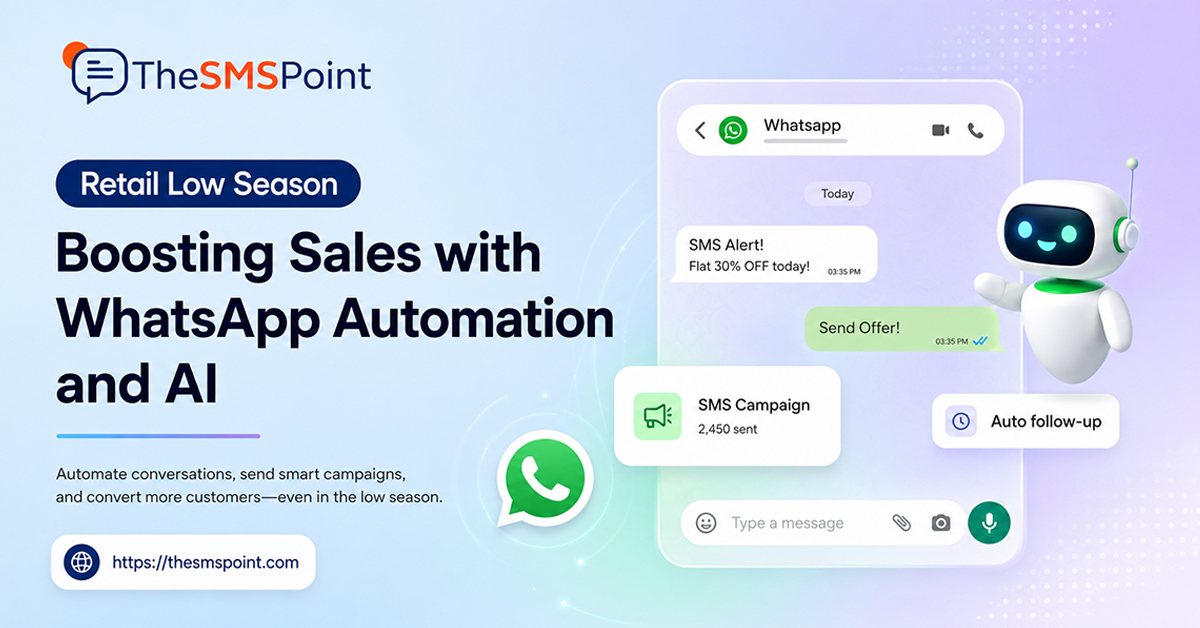
Slow sales, fewer customers, and declining engagement? Discover how WhatsApp automation and AI can help retailers turn seasonal challenges into new business opportunities.
Every retail business experiences periods when customer demand slows down. Whether it’s after a festive shopping season, during off-peak months, or between major promotional events, reduced footfall and fewer purchases can affect revenue.
But a retail low season doesn’t have to mean losing customer relationships.
With WhatsApp automation for retail, businesses can reconnect with existing customers, promote relevant products, automate conversations, and create personalized shopping experiences.
When combined with AI-powered communication and targeted SMS marketing, these strategies can help retailers maintain engagement and generate additional sales opportunities.
Let’s explore how retailers can use WhatsApp automation and AI to make their quieter months more productive.
Why Do Retail Sales Slow Down During Off-Peak Seasons?
Retail demand changes throughout the year due to consumer spending patterns, holidays, product demand, and market conditions.
During quieter periods, retailers often experience reduced store visits, slower inventory movement, and lower engagement with promotional campaigns.
Traditional marketing methods may not always provide the targeted communication businesses need.
Instead of relying entirely on large discounts, retailers can focus on maintaining relationships with customers who have already shown interest in their products.
Common Low-Season Retail Challenges
Retail Challenge |
Business Impact |
Marketing Opportunity |
| Reduced Customer Footfall | Fewer in-store purchases | Personalized WhatsApp offers |
| Slow-Moving Inventory | Increased holding costs | Targeted clearance campaigns |
| Inactive Customers | Fewer repeat purchases | Automated re-engagement |
| Abandoned Shopping Carts | Missed sales opportunities | Timely cart reminders |
| Limited Marketing Resources | Inconsistent communication | Automated customer journeys |
The goal is not simply to send more promotional messages. It is to deliver relevant communication when customers are most likely to find it useful.
1. Reconnect with Customers Through Personalized WhatsApp Campaigns
Customers are more likely to engage with offers that match their interests than with generic promotional messages. WhatsApp marketing allows retailers to segment opted-in customers based on previous purchases, product preferences, location, and engagement history.
For example, a fashion retailer could send a seasonal collection offer to customers who previously purchased similar products. An electronics store might notify interested customers about accessories or relevant product bundles.
How Personalized Campaigns Support Sales
Retailers can create campaigns around:
- Exclusive offers for returning customers.
- Discounts on selected product categories.
- New arrivals matching previous interests.
- Loyalty rewards and repeat-purchase incentives.
- Limited-period promotions during quieter weeks.
A personalized campaign can make customers feel that the business understands their preferences.
Retail insight: Relevant offers and thoughtful timing can encourage repeat engagement without overwhelming customers with promotional messages.
2. Use AI-Powered Chatbots to Keep Customer Conversations Active
What happens when a customer asks about product availability after business hours? Without automation, that inquiry may remain unanswered until the next working day.
An AI-powered WhatsApp chatbot can assist with common questions, provide product information, and help customers navigate the buying process.
AI Chatbot Applications in Retail
Customer Requirement |
AI-Powered Assistance |
Business Advantage |
| Product Information | Answer common product questions | Faster assistance |
| Order Tracking | Retrieve available order updates | Better customer experience |
| Product Discovery | Suggest relevant products | Improved engagement |
| Store Information | Share locations and working hours | Convenient communication |
| Customer Support | Route complex queries to staff | Better service coordination |
For example, a customer looking for running shoes could interact with a chatbot to explore available sizes, product categories, and price ranges. When a question requires personal assistance, the conversation can be transferred to a human representative.
Retail insight: AI-assisted conversations can help retailers remain responsive while allowing employees to focus on more complex customer needs.
3. Recover Missed Opportunities with Automated Follow-Ups
Not every customer completes a purchase during their first interaction. Some browse products, compare prices, or abandon their shopping carts before checkout. Without timely follow-ups, retailers may lose valuable opportunities to reconnect.
WhatsApp automation can support carefully timed reminders based on customer actions and messaging preferences.
Effective Follow-Up Strategies
| Customer Activity | Automated Communication | Objective |
| Abandoned Cart | Shopping cart reminder | Encourage purchase completion |
| Product Inquiry | Relevant product follow-up | Continue the conversation |
| Completed Purchase | Thank-you or service message | Strengthen customer relationships |
| Repeat Customer | Personalized loyalty offer | Encourage future purchases |
| Customer Feedback | Review or feedback request | Improve customer experience |
For instance, an online retailer could send an eligible customer a reminder about an unfinished purchase, with a convenient link to return to checkout. Promotional follow-ups must respect customer consent and applicable WhatsApp messaging rules.
Retail insight: A useful follow-up can bring customers back into the buying journey without relying on repeated sales messages.
4. Combine WhatsApp and SMS Marketing for Better Customer Reach
WhatsApp is effective for interactive conversations, while SMS remains useful for concise alerts and timely communication. Rather than treating these channels as competitors, retailers can use them together within a coordinated marketing strategy.
WhatsApp Marketing vs SMS Marketing
| Feature | WhatsApp Marketing | SMS Marketing |
| Communication Format | Text, images, videos, interactive buttons | Primarily text messages |
| Customer Interaction | Supports two-way conversations | Depends on SMS setup |
| Automation | Chatbots and workflow integrations | Scheduled and triggered messages |
| Common Retail Uses | Product discovery, offers, customer support | Alerts, reminders, promotional updates |
| Internet Requirement | Required for recipients | Not required for standard SMS |
For example, a retailer could use an SMS alert to announce a seasonal promotion and an opted-in WhatsApp conversation to answer product questions or share a catalog. The right channel depends on customer preferences, campaign objectives, and applicable messaging regulations.
Retail insight: Coordinated communication across channels can help businesses maintain customer engagement throughout the shopping journey.
5. Measure Campaign Performance and Improve Retail Marketing ROI
Sending thousands of promotional messages does not automatically generate sales. Successful retail marketing automation requires businesses to understand how customers respond and which campaigns produce meaningful outcomes.
WhatsApp and SMS campaign analytics can provide insights into message delivery, customer responses, engagement, and conversions, depending on the tools and integrations used.
Key Retail Marketing Metrics
| Performance Metric | What It Measures |
| Message Delivery Rate | Messages successfully delivered |
| Customer Response Rate | Recipients who respond |
| Click-Through Rate | Engagement with campaign links |
| Conversion Rate | Customers completing desired actions |
| Revenue per Campaign | Sales attributed to a campaign |
| Return on Investment | Financial return relative to campaign costs |
For example, a retailer can compare results from a loyalty offer and a clearance campaign to determine which approach generates better customer engagement. AI-assisted insights may also help businesses identify purchasing patterns and improve future audience segmentation.
Retail insight: Focus on campaign quality, customer satisfaction, and measurable sales rather than simply increasing message volume.
How TheSMSPoint Helps Retailers Improve Customer Engagement
Building effective communication campaigns requires the right combination of automation, customer insights, and messaging tools.
TheSMSPoint provides business messaging solutions that support WhatsApp communication, bulk SMS campaigns, automated customer interactions, and personalized engagement.
Retail businesses can explore features such as:
- WhatsApp Business API solutions for customer messaging.
- Automated replies and chatbot-based assistance.
- Personalized marketing campaigns.
- Bulk SMS for promotional and transactional communication.
- Customer engagement workflows and follow-ups.
- Campaign performance tracking and reporting.
These capabilities can help retailers organize customer conversations and create more consistent communication throughout seasonal demand changes. Businesses should use approved WhatsApp message templates where required, obtain appropriate customer consent, and respect opt-out requests.
Frequently Asked Questions
1. How can WhatsApp automation increase retail sales?
WhatsApp automation can support personalized promotions, faster inquiry responses, shopping cart reminders, and customer re-engagement, potentially creating more sales opportunities.
2. Can small retail businesses use WhatsApp automation?
Yes. Small retailers can begin with automated responses, customer segmentation, promotional campaigns, and basic follow-up workflows based on their needs.
3. How does AI improve WhatsApp marketing?
AI can help answer common questions, recommend relevant products, organize customer conversations, and assist with campaign personalization.
4. Is WhatsApp better than SMS for retail marketing?
Both have advantages. WhatsApp supports interactive conversations and rich media, while SMS is suitable for concise updates and customers without mobile internet access.
5. Can retailers send promotional WhatsApp messages automatically?
Yes, subject to customer opt-in, platform policies, applicable message-template requirements, and messaging regulations.
Conclusion: Turn the Retail Low Season into an Engagement Opportunity
A retail slowdown doesn’t have to mean losing momentum. With personalized WhatsApp campaigns, AI-powered chatbots, automated follow-ups, and targeted SMS marketing, retailers can stay connected with customers and create meaningful opportunities for repeat business. The key is to focus on relevant communication, customer preferences, and measurable outcomes.
Ready to make your retail marketing smarter, even during the low season?
Explore WhatsApp automation, AI-assisted communication, and SMS marketing solutions at TheSMSPoint.
Connect smarter. Engage better. Grow beyond the season.