Your customers are receiving more business messages than ever. The real challenge isn’t sending another notification, it’s choosing the right channel to make every interaction relevant.
Imagine sending a payment reminder that customers never notice, a promotional offer that receives little engagement, or a delivery update that arrives without enough information.
These communication gaps can affect customer experience and campaign performance.
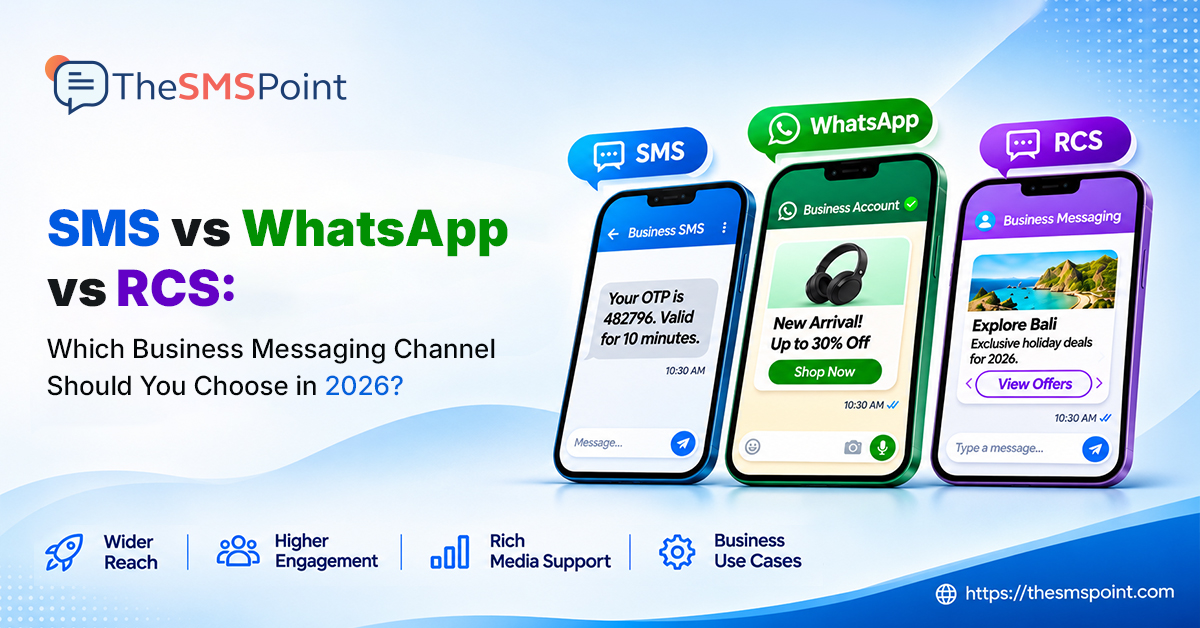
In 2026, businesses have three important mobile messaging options: SMS, WhatsApp Business, and RCS (Rich Communication Services).
Each offers different capabilities, costs and customer experiences.
So, which channel should your business choose?
The answer depends on your communication objective. SMS is well suited to concise alerts and broad reach, WhatsApp supports interactive customer conversations and RCS combines rich, branded messaging with the phone’s native messaging experience.
Let’s compare them.
Understanding the Three Business Messaging Channels
1. SMS: Simple, Direct and Widely Accessible
SMS (Short Message Service) is a traditional mobile messaging technology that allows businesses to send text messages to customers without requiring a separate messaging application.
It remains useful for:
- One-time passwords (OTPs)
- Transaction notifications
- Appointment reminders
- Payment alerts
- Order confirmations
- Time-sensitive service updates
One of SMS’s biggest advantages is accessibility. It works across conventional mobile phones and smartphones without requiring mobile internet access.
However, standard SMS has limited multimedia and interactive capabilities. Businesses looking for dependable text-based communication can explore Transactional SMS Services from TheSMSPoint.
2. WhatsApp Business: Interactive Customer Engagement
WhatsApp Business messaging allows organizations to communicate through an application many customers already use.
For larger operations, the WhatsApp Business Platform supports automation, approved message templates, customer support workflows and integration with business systems.
Businesses can use WhatsApp for:
- Personalized marketing campaigns
- Customer support conversations
- Product recommendations
- Order and delivery updates
- Appointment confirmations
- Automated customer interactions
Unlike traditional SMS, WhatsApp supports images, videos, documents, buttons and interactive conversations.
However, customers must have WhatsApp access and businesses must follow Meta’s messaging policies, including applicable opt-in and template requirements.
Explore WhatsApp Business API Solutions to understand its business communication capabilities.
3. RCS: Rich Messaging Within the Native Inbox
RCS is an advanced messaging standard that enables businesses to send more interactive content through supported messaging applications.
RCS for Business can support verified branding, rich media, carousels, suggested replies and actionable buttons. For example, a retail brand can display products with images and clickable options within a messaging conversation.
Unlike WhatsApp, customers do not need to install a dedicated third-party business messaging application when their device and messaging service already support RCS.
However, RCS availability depends on device, carrier, messaging application and regional support. For unsupported recipients, businesses should plan an SMS fallback strategy.
Discover RCS Messaging Solutions for branded and interactive customer communication.
SMS vs WhatsApp vs RCS: Key Differences
| Feature | SMS | WhatsApp Business | RCS |
| Internet Required | No | Yes | Yes |
| Separate App Required | No | No dedicated third-party app on supported devices | |
| Images & Videos | Not in standard SMS | Yes | Yes |
| Interactive Buttons | No | Yes | Yes |
| Two-Way Messaging | Supported through suitable services | Yes | Yes |
| Branding | Sender ID where supported | Business profile | Verified business branding |
| Best For | OTPs, alerts, reminders | Conversations, support, marketing | Rich promotions and interactive updates |
| Main Limitation | Limited rich content | App dependence and platform rules | Device and network compatibility |
The comparison highlights an important point: no single messaging channel is ideal for every business interaction.
Which Messaging Channel Is Best for Your Business?
Choose SMS for Essential Notifications
If your priority is delivering short, important information to a broad mobile audience, SMS is often a practical choice. For example, banks, e-commerce platforms and service providers can use SMS for verification codes and transaction updates.
Its simplicity makes it useful when multimedia or extended conversations are unnecessary.
Choose WhatsApp for Conversations and Customer Support
WhatsApp is particularly useful when customers need to ask questions, receive personalized assistance, or interact with automated workflows.
Businesses can connect WhatsApp messaging with CRM systems, customer support platforms and e-commerce applications.
This makes it valuable for lead nurturing, service inquiries and ongoing customer engagement.
Choose RCS for Interactive Brand Experiences
RCS can be effective when businesses want to deliver visually engaging information directly through compatible native messaging applications.
Retail promotions, travel bookings, product launches and interactive service notifications are potential use cases. Branded messages and action buttons can simplify the customer journey.
However, businesses should verify audience compatibility before relying on RCS as their only channel.
What About Pricing and ROI?
Messaging costs differ across channels. SMS is commonly billed by message volume, destination and message segments.
WhatsApp Business Platform pricing depends on factors such as message category, recipient market and applicable provider fees. RCS pricing can vary by carrier, aggregator, region and message type.
Instead of choosing solely on cost per message, businesses should evaluate:
- Delivery and response rates
- Customer engagement
- Campaign conversion rates
- Cost per successful interaction
- Automation requirements
- Total platform and integration expenses
The cheapest message is not necessarily the most cost-effective business communication.
A higher-cost interactive message may create more value when it helps customers complete an important action.
Compliance Matters: What Indian Businesses Should Know
In India, commercial SMS communication is governed by TRAI’s telecom regulations.
Applicable requirements include registration of the principal entity, sender headers, content templates and relevant consent processes through the DLT framework.
WhatsApp businesses must follow Meta’s Business Messaging Policy and obtain appropriate customer opt-ins.
RCS campaigns also require attention to platform policies, sender verification, user consent and applicable regulations.
Businesses should maintain accurate consent records, respect customer preferences and provide appropriate opt-out mechanisms.
Compliance is not simply a regulatory obligation. It also supports trustworthy customer communication.
Why a Multichannel Messaging Strategy Works Better
Rather than selecting only one messaging channel, many businesses can benefit from combining them.
Consider an e-commerce customer journey:
Step 1: Send an order confirmation through SMS.
Step 2: Share delivery information through WhatsApp when the customer has opted in.
Step 3: Use RCS to present interactive product recommendations to compatible recipients who have agreed to receive marketing.
Step 4: Use an appropriate fallback channel when the preferred messaging service is unavailable.
This approach matches the message format to the customer’s needs and technical capabilities. It also allows businesses to measure performance across different communication stages.
How TheSMSPoint Supports Business Messaging
TheSMSPoint provides messaging solutions for organizations looking to manage transactional notifications, promotional campaigns and customer engagement.
Its offerings include:
- Transactional and Promotional SMS
- OTP Messaging
- WhatsApp Business API
- RCS Messaging
- Two-Way Messaging
- API-Based Communication Integration
Businesses can explore these solutions to develop a messaging approach based on their audience, campaign objectives and operational requirements.
Visit TheSMSPoint to explore available business messaging services.
Frequently Asked Question
1. Is RCS better than SMS?
RCS offers richer branding and interaction, while SMS provides broader compatibility with conventional mobile devices. The better option depends on the message and recipient.
2. Which is better for business marketing: WhatsApp or SMS?
WhatsApp is useful for interactive, permission-based campaigns. SMS is suitable for concise promotions and notifications that do not require a separate messaging application.
3. Can RCS replace SMS completely?
Not universally. RCS availability depends on recipient compatibility, making SMS fallback important for many implementations.
4. Can businesses use all three messaging channels?
Yes. A coordinated strategy can use SMS for alerts, WhatsApp for conversations and RCS for rich interactive experiences, subject to consent and platform requirements.
Final Verdict: Choose the Channel That Fits the Message
In 2026, successful business messaging is not about declaring SMS, WhatsApp, or RCS the universal winner.
It is about delivering the right information through the right channel at the right moment.
Choose SMS for accessibility, WhatsApp for conversations and RCS for rich branded interactions.
For businesses looking to combine these capabilities, TheSMSPoint offers communication solutions worth exploring.
Ready to improve your business messaging strategy?
Visit TheSMSPoint or call +91 8260003333 to discuss your communication requirements.